
For questions asked by individuals, responses are grouped by topic. Click a topic to open.
- Question: Where do you stand on LGBTQ issues and supports?
- By: Nora
- Jamie’s Answer:
- Human rights are the central pillar of my entire platform. For example, I believe it’s a given that trans rights are human rights; this is not up for debate.
I have been a loud advocate for issues impacting the community, including the rapid backsliding toward fascism by right wing governments in Canada and beyond.
I am fully committed to using every privilege, platform, and lever of power I have to continue to advocate for my fellow 2SLGBTQIA+ community members.
- Human rights are the central pillar of my entire platform. For example, I believe it’s a given that trans rights are human rights; this is not up for debate.
- Question: Hi Jamie Hari, I look forward to voting for you. I am wondering if you have any lawn or window signs — I would be thrilled to have one. I will share my address with you if so, but since this is posted publicly when answered, I won’t put that here lol. Good luck!!!
- By: Lindsay H.
- Jamie’s Answer:
- Thank you so much for your kind words of support!
At the very outset of this election, I made the conscious decision not to spend any money on my campaign (beyond the website) or to accept any donations whatsoever.
Despite the obvious reach disadvantage, I feel strongly about it for two primary reasons:
1. De-financialization of elections.
For the same reason that we need to entirely remove the profit motive from food and shelter, I believe elections should be decided solely on principled policy stances, without the need to spend significant amounts of money – out of reach of most folks. If municipal elections cost tens of thousands of dollars and federal elections cost nearly a hundred thousand dollars to win, then democracy isn’t for the average person.
2. Environmental responsibility.
Like one of my friends and political inspirations, Tony McQuail, I am trying to be pragmatic while making a political statement by limiting the ecological impact of my campaign. I genuinely believe that socialist messaging is best received when shared among community by word-of-mouth.
For these reasons, I am asking supporters to instead please share my name and platform with friends, family, and members of your communities.
- Thank you so much for your kind words of support!
- Question: I’m trying to guage how much the public knows about you and your policies. Other than your website, doing surveys and participating in debates, I’m wondering about what other campaigning did you do? Did you knock on doors in Waterloo? How was the response?
I was reading an article about you on the Record, and in it you said you thought you were unlikely to win. TBH, it made me feel disappointed because it sounded like you were not serious about pursuing this position.
The reason I’m emailing you is that I believe Waterloo deserves a more ambitiously progressive candidate than what we currently have. Someone who would dare say no to the loads of money we give the police. Someone who decides to be kind to our homeless/unhoused neighbors.- By: Zackari R.
- Jamie’s Answer:
- I knocked on doors during the early days of the campaign, mostly in my own ward, but I am unable to take unpaid time off work to campaign full time. For that reason, I’ve prioritized attending organizational events such as the WRLC’s Labour Day picnic, PYM’s March for Palestine, the MACA street BBQ, and CUPE 1883’s session on Doug Ford’s attempt to privatize water. The full list of events I’ve attended and am planning on attending can be found here.
You are not the first person to express disappointment in my comment to Jeff Outhit in the Waterloo Record. It was meant to be realistic, not pessimistic. I also mentioned in that interview that I am very much serious about running and would take the role entirely seriously, should I win.
I certainly have already made a far bigger impact than I had expected, especially considering I consciously decided to go without donations or ads of any kind. While there aren’t any official polls, many voters and other candidates have suggested I am very much in the running among a split race!
My positions on defunding the police and guaranteeing food and shelter as human rights stand as a stark contrast to my fellow candidates.
- I knocked on doors during the early days of the campaign, mostly in my own ward, but I am unable to take unpaid time off work to campaign full time. For that reason, I’ve prioritized attending organizational events such as the WRLC’s Labour Day picnic, PYM’s March for Palestine, the MACA street BBQ, and CUPE 1883’s session on Doug Ford’s attempt to privatize water. The full list of events I’ve attended and am planning on attending can be found here.
- Question: What is your opinion regarding data centres in the City of Waterloo?
- By: Ben B.
- Jamie’s Answer:
- There’s nothing inherently wrong with data centres, AI, or robotics. These are just tools, like the hammer or the screwdriver. The issues I have with them are: firstly how they’re being used (i.e., for profit and power at any cost) and secondly with how they’re negatively impacting our already decimated environment.
While I am vehemently against hyperscale data centres for the purposes of generating AI slop, my career has been spent designing, selling, and supporting data centre and cybersecurity software and services. Data centres are central to my livelihood, but they shouldn’t come at the cost of humanity.
- There’s nothing inherently wrong with data centres, AI, or robotics. These are just tools, like the hammer or the screwdriver. The issues I have with them are: firstly how they’re being used (i.e., for profit and power at any cost) and secondly with how they’re negatively impacting our already decimated environment.
- Question: What are your thoughts on EDI (Equity Diversity and Inclusion)? In your response please speak to if EDI initiatives should be funded more/less, if those funding changes should be internal (staffing capacity, budget etc) and/or external (community organization support) and any other thoughts you have.
- By: Anonymous.
- Jamie’s Answer:
- I fully support continued and increased investment of time, money, and political willpower into DEI initiatives.
The problems faced by the most vulnerable among us that are mitigated by DEI have not been solved; in fact, we’ve been rapid backsliding in Canada which has only accelerated since Donald Trump was re-elected. Systemic racism, homophobia, transphobia, Islamophobia, antisemitism, and ablism are bad and getting worse.
DEI alone will not fix these issues, but it does form the strong foundation on which other solutions build.
- I fully support continued and increased investment of time, money, and political willpower into DEI initiatives.
- Question: TL;DR How do you plan to advocate for the city’s post-secondary institutions to fully subsidize tuition for Waterluvians? First, post-secondary education is a provincial jurisdiction. Second, local institutions are currently under large operational deficits, making it difficult for them to absorb the loss in tuition fees. Finally, implementing free tuition based strictly on city borders penalizes students from Kitchener who are essentially equidistant from these institutions. Given that a mayor lacks the budget, legal jurisdiction, and institutional power to mandate student fees, what mechanism will you use to deliver on this promise?
- By: A. W.
- Jamie’s Answer:
- The promise stated in my platform is to advocate for free post-secondary education, not to guarantee it through the mayoral office or as a singular councilor on the Regional Council under a Strong Regional Chair that has veto power. As you correctly point out, there are effectively no levers of power to directly manifest this.
Because higher education is so far out of reach for the budget of the City and even the Region, this is not a high priority for my platform. Instead, I would use every reasonable opportunity that presented itself to loudly and publicly advocate for additional funding from both the provincial and federal governments – and to call attention to Doug Ford’s corruption as it relates to the OSAP cuts.
- The promise stated in my platform is to advocate for free post-secondary education, not to guarantee it through the mayoral office or as a singular councilor on the Regional Council under a Strong Regional Chair that has veto power. As you correctly point out, there are effectively no levers of power to directly manifest this.
- Question: What role do you believe our public library plays in supporting community wellness, and how will your budget priorities reflect that?
- By: Olga M.
- Jamie’s Answer:
- Libraries have been defunded and forgotten by many governments, especially since the dawn of the Internet. 30 years since then, it’s more clear to me than ever that libraries serve a much more critical part of society than just “where the books are.”
Libraries are community centres. They provide safe meeting spaces and supports for community groups, school trips, retirees, and many more folks.
While physical books are often seen as less relevant in 2026, the purpose of libraries was always access to knowledge, not paper, ink, and glue. Many people use libraries to access the Internet, not just for research but also for job applications and keeping in touch with distant family and friends. Beyond books, many folks aren’t even aware that you can borrow musical equipment, comic books, and tools!
I believe libraries are core to the functioning of democracy and so should be well-staffed by unionized employees and should be resourced adequately to meet the growing and rapidly changing needs of residents. They are every bit as important now as they were a thousand years ago. I would commit to keeping the library system budget at or above inflation. It’s ridiculous that police get annual increases larger than inflation, while libraries and transit are left to fend for budgetary scraps.
- Libraries have been defunded and forgotten by many governments, especially since the dawn of the Internet. 30 years since then, it’s more clear to me than ever that libraries serve a much more critical part of society than just “where the books are.”
- Question: While I agree with your other platform points, why do you have a long-term goal of free tuition at three local post-secondary institutions, for Waterluvians? What about basing tuition support on income instead? And while JK-gr. 12 education is under the control of the Ontario government, might there be some education-related programming for kids and youth that Waterloo could support, such as lunch/arts/sports/homework help programs?
- By: Kristen M.
- Jamie’s Answer:
- I expect large initiatives like this to be broken down into phases, often taking several years. While I’d like to see transit free for everyone, for instance, I’d start with students and seniors.
You’re absolutely right that the same logic should apply to post-secondary education. I believe education is a human right, and so should be provided to everyone for free. With that said, this is a relatively low priority for my platform.
I would certainly advocate for short-term measures to facilitate access to our local institutions for our city’s residents, but food, shelter, and transit are my top priorities. To your point, a city-wide school lunch program would be much higher priority than free university.
I also believe strongly that arts and sports are integral parts of strong communities and would commit to increasing investment in these areas.
- I expect large initiatives like this to be broken down into phases, often taking several years. While I’d like to see transit free for everyone, for instance, I’d start with students and seniors.
- Question: Looking at the last election results, I’m worried about vote splitting in this mayoral race. We know the consequences can be devastating and unrepresentative of the populace’s values. How would you encourage individuals to work with this, and what will it really take to see electoral reform at any level?
- By: Anonymous.
- Jamie’s Answer:
- I believe strongly that electoral reform is necessary. I think ranked choice makes sense for elections without parties, like this mayoral race.
With that said, I’m not worried about vote-splitting in this election. My platform is the only one that is materially different. Looking solely at policies, the other four candidates are nearly interchangeable and will be splitting from a similar voter pool. Relatedly, I am consciously losing votes by being openly socialist, pro-land back, and pro-Palestine. Of course, there’s no accounting for personal relationships that candidates have established in the community, but for every other voter I stand very much apart from the pack.
At the provincial and federal level, we need proportional representation. There are pros and cons to each, but I like Mixed-Member Proportional (MMP) or Single Transferable Vote (STV). Regardless, First Past the Post (FPTP) has got to go!
An analysis of our political positions by Vote Compass:
- I believe strongly that electoral reform is necessary. I think ranked choice makes sense for elections without parties, like this mayoral race.
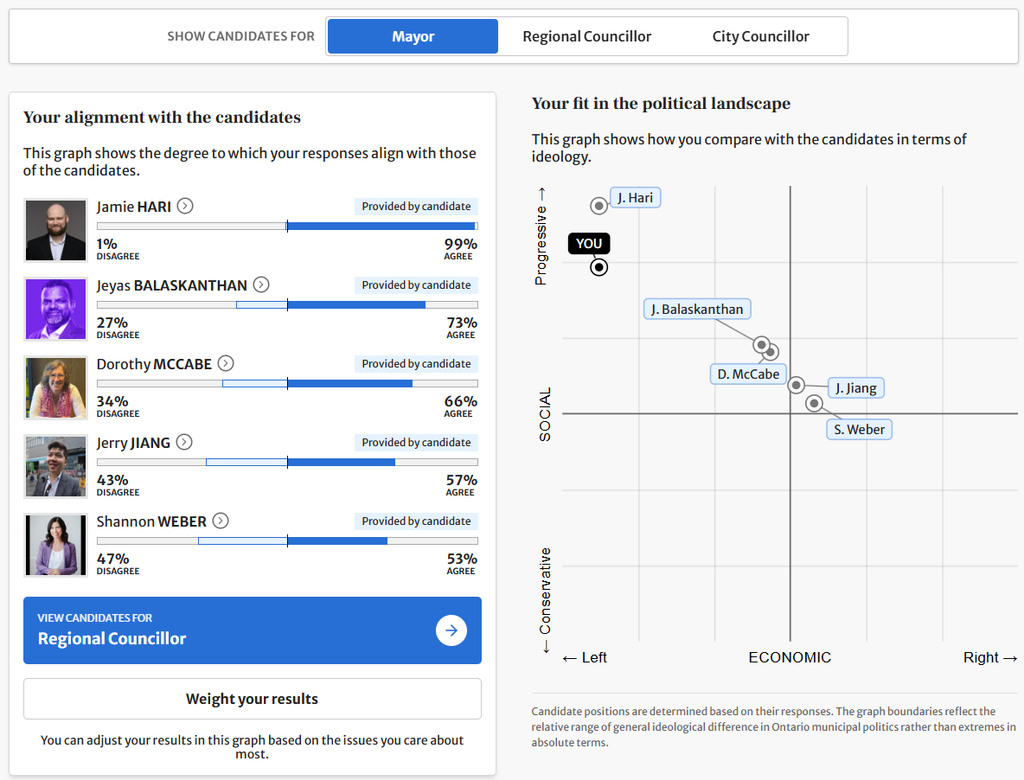
- Question: Can the city ban front lawns and ask citizens to grow flower gardens instead? This would cut the number of lawns needoing to be cut and sprayed and treated etc, which is a total waste.
- By: Shirley F.
- Jamie’s Answer:
- Something tells me that you may already know that the modern North American front lawn was styled after European estates and castles as an ostentatious sign of wealth. The purpose was literally to demonstrate that you were so wealthy that you could afford to waste good arable land.
I would fully support a significant reduction or even complete ban on front lawns in new developments. The whole of suburban design needs to be dramatically rethought, with priority given to people and the environment, not cars.
- Something tells me that you may already know that the modern North American front lawn was styled after European estates and castles as an ostentatious sign of wealth. The purpose was literally to demonstrate that you were so wealthy that you could afford to waste good arable land.
- Question: Hi Jamie! First of all, I’d like to say I’m hugely supportive of all your stated goals and values. It is refreshing to see someone with human-centered ideals in this climate. My question for you is your stance on Generative A.I., and A.I. data centers. Do you support A.I. data centers being built in Waterloo, or generally in Canada? Thank you! Best of luck to yourself and your team.
- By: Kip.
- Jamie’s Answer:
- I’ll start with the answer I gave about data centres generally, then expand a bit:
“There’s nothing inherently wrong with data centres, AI, or robotics. These are just tools, like the hammer or the screwdriver. The issues I have with them are: firstly how they’re being used (i.e., for profit and power at any cost) and secondly with how they’re negatively impacting our already decimated environment.
While I am vehemently against hyperscale data centres for the purposes of generating AI slop, my career has been spent designing, selling, and supporting data centre and cybersecurity software and services. Data centres are central to my livelihood, but they shouldn’t come at the cost of humanity.”
I fully support maintaining the data centres we have historically used to operate our critical infrastructure, like email, water treatment plants, and electrical grid. We absolutely don’t need new hyper-scale data centres to pump out slop videos of cats singing and playing musical instruments.
I’ll add that ‘generative AI’ is not actually generative. The current generation of Large Language Models (LLMs) are actually guessing machines, which are designed to have increasingly accurate guesses as they study the sum total of documented human-generated information. This is not a political statement, but rather my professional analysis – as someone who has worked with various flavours of AI for nearly 20 years. Most current models were trained on copyrighted material without compensating artists and authors; in any other context, we’d call this blatant theft. So why not here?
- I’ll start with the answer I gave about data centres generally, then expand a bit:
- Question: Fiscal management is one of the biggest issues for me. You proposed to both spend more on things and cut funds on other things. Do you believe you can lower our yearly deficits or even balance the budget, with supporting evidence?
- By: Anonymous
- Jamie’s Answer:
- The short answer is no, I don’t actually believe I can.
Since Bill 100 (the ironically named ‘Better Regional Governance Act’) came into effect earlier this year, thousands of mayors, city councilors, and regional councilors in regions all across the province have lost what little power they previously had to implement these or any other changes.
The previously-elected Regional Chair position has been replaced with a role appointed by Doug Ford that has effective veto power over mayors and councils. The Premier has been intentionally and systematically depowering municipal governments across Ontario for years, while simultaneously shielding himself and colleagues from Freedom of Information Act (FOIA) requests which might hold him accountable.
I expect most of my proposals, especially ones like defunding the WRPS and significantly increasing taxes on the wealthiest, would be stopped instantly by Doug Ford via his proxy, this new ‘Strong Regional Chair.’
If a decision made unanimously by the mayor and council can be unilaterally defeated by an unelected friend of the Premier, then mayors, councils, and municipal elections are largely ceremonial positions just responsible for naming streets, cutting ribbons, and taking the blame next election.
- The short answer is no, I don’t actually believe I can.
- Question: I have a couple of questions regarding the significant infrastructure funding gap highlighted in the recent Asset Management Plan: 1. What is your plan to address this funding gap, and what alternative funding options would you explore to help close it?
- By: Mehdi
- Jamie’s Answer:
- My funding plan, in short, has two prongs: 1) Slash Waterloo Regional Police Service (WRPS) spending by half and 2) implement proportionality across all taxes, fees, and fines. The middle class and the most vulnerable Waterluvians simply can’t afford to contribute any more than they already are, so the difference must be made up by our wealthiest citizens and largest businesses.
Please see my full platform for more details.
- My funding plan, in short, has two prongs: 1) Slash Waterloo Regional Police Service (WRPS) spending by half and 2) implement proportionality across all taxes, fees, and fines. The middle class and the most vulnerable Waterluvians simply can’t afford to contribute any more than they already are, so the difference must be made up by our wealthiest citizens and largest businesses.
- Question: What is your plan to improve integrated project delivery and coordination? The current Columbia Street watermain replacement is a good example. Drivers will have to deal with temporary resurfacing for roughly a year and half before the final resurfacing of the entire section is completed in 2028. Is there an opportunity to improve coordination between infrastructure projects to minimize disruption, reduce costs, and avoid repeated work?
- By: Mehdi
- Jamie’s Answer:
- For future projects, I would propose including strict Service Level Agreements (SLAs) into all outsourced contracts, including clear and significant financial and non-monetary penalties for contractors that violate them.
Many infrastructure projects have funding arrangements where some amount of capital is paid upon the start of work, which incentivizes them to dig up the road right away to collect the initial funds – long before it makes operational sense to begin demolition. We would introduce limits to the number of hours or days in advance of work that demolition, road grooving, lane closures, or any other inconveniences that are necessarily created by construction work.
The Columbia Street watermain replacement has been particularly irksome to me, too. It was an absolutely massive planning failure to rip up one of the busiest streets around the universities during the first week of school. Who thought that was a good idea?! We should definitely consider introducing non-emergency construction freezes in busy areas during their critical times of the year. This is easier said than done, but this Columbia Street issue could have easily been avoided.
Creating better coordination starts with stricter communication and documentation requirements from contractors. This means also including binding requirements for private organizations to be more responsive and transparent with the City and Region, reducing miscommunications and misunderstandings that contribute to project delays and cost overruns.
I don’t have enough information to speak about reducing repeated work, although I suspect there are several causes which need addressing, not just a single root cause, and better coordination in general will help greatly.
- For future projects, I would propose including strict Service Level Agreements (SLAs) into all outsourced contracts, including clear and significant financial and non-monetary penalties for contractors that violate them.
- Question: What are the implications to the police force if it is defunded?
- By: Darryl U.
- Jamie’s Answer:
- There are three main parts to consider: timing, alternative resourcing, and limitations.
Unfortunately, defunding the police is neither an instantaneous nor straightforward process. Like any other significant project, it would be broken down into phases with milestones and measured publicly against success metrics. Even with hypothetical broad support from Regional Council and even assuming Doug Ford’s Strong Regional Chair doesn’t veto the motion, I still don’t expect the process would be achievable within a 4-year term in office.
The key to the whole idea is what we do with the resources instead of spending them on gun-carrying police. Both statistical and anecdotal analyses agree that housing-first strategies for people experiencing homelessness yield an economic multiplier effect. This means that for every dollar spent more than a dollar is saved in policing, healthcare, prisons, and other social services. The bulk of spending on police recovered would be re-allocated to non-market housing and a non-profit public grocer. We know poverty is the single largest driver of petty crime. Another specific example of alternative resourcing involves responding to mental health crises with highly-trained trauma-informed social workers, instead of armed police – that have been shown to escalate more often than they de-escalate.
The third part is acknowledging the practical limitations to defunding the police. For starters, the OPP and RCMP fall outside the Region’s scope of influence and would continue their local operations largely unimpacted. Perhaps the most common concern with ‘defunding the police’ is how to deal with urgent and non-urgent violence. A combination of civilian community safety teams and a wholly-reformed Regional police is the realistic short-term answer.
- There are three main parts to consider: timing, alternative resourcing, and limitations.
- Question: Can you clarify more on what the community security service would be like compared to the current police system?
- By: Justin C.
- Jamie’s Answer:
- The core components that contrast most starkly against the current police system include: civilian-centered mental health response teams, youth outreach workers, restorative justice programs, and trauma-informed social workers.
Associate Editor of The John Howard Society of Canada, Emily Stewart, wrote in 2023 about a new report from Toronto that confirmed “police often do not improve community safety and may instead deepen systemic injustices.”
An example she cites is a civilian mental health crises response team that now handles “20% of all police calls and focus[es] on de-escalation, offering service referrals, and providing general support.”
Admittedly, there are people far more qualified than me to further explain the best approaches with nuance. What I can say for certain is that the police are not those people.
- The core components that contrast most starkly against the current police system include: civilian-centered mental health response teams, youth outreach workers, restorative justice programs, and trauma-informed social workers.
- Question: Hi Jamie, I’m trying to understand what you meant by “so-called Canada”. I don’t disagree with the sentiment in the direction but did not understand why you added this. Thanks,
- By: Jeff W.
- Jamie’s Answer:
- “So-called Canada” is a term used by advocates for Indigenous Peoples rights and the Land Back movement more broadly. It acknowledges that some land that comprises what is currently called Canada, such as the Haldimand Tract on which Waterloo sits, was not ceded. This specific case is currently before the (Canadian) courts.
- Question: How would you describe your leadership style?
- By: Peter M. (Voice4.com)
- Jamie’s Answer:
- I’ve been a person-manager for more than 15 years; it’s been perhaps the best part of my professional career. I believe the role of leaders is to support and enable team members with everything they need to be successful in their roles – not to dictate to them how to do their jobs. I believe democracy extends even to the workplace. With that said, I also believe the leader’s job includes influencing and educating peers, such as city and regional councilors and city staff.
Unfortunately, the role of Mayor has been intentionally disempowered by provincial legislation in Ontario, especially by the new law that makes Regional Chairs appointed positions and gives them absolute veto powers over elected Mayors. This greatly diminishes ALL mayors’ ability to make impactful changes. I will push back hard against Doug Ford’s undemocratic changes!
- I’ve been a person-manager for more than 15 years; it’s been perhaps the best part of my professional career. I believe the role of leaders is to support and enable team members with everything they need to be successful in their roles – not to dictate to them how to do their jobs. I believe democracy extends even to the workplace. With that said, I also believe the leader’s job includes influencing and educating peers, such as city and regional councilors and city staff.
- Question: Do you recognize the Genocide in Gaza and have you spoken out about it?
- By: Annmarie B.
- Jamie’s Answer:
- Yes, I unreservedly recognize Israel’s actions in Gaza and the West Bank as genocide and consequently support the ICC arrest warrants for Netanyahu and the other Israeli officials.
Canada is violating several domestic and international laws by continuing to supply Israel with weapons and other war materiel by delivering parts under generic labels and by shipping through intermediaries (e.g., America, UK). Moreover, I believe Mark Carney puts Canada further in violation of our obligations to the ICC each time he grants Netanyahu approval to fly through Canadian airspace. To be clear, this is not implicit consent; Mark Carney has explicitly instructed CAF to allow passage despite the arrest warrant.
I’ve been vocally pro-Palestine for years now, although I was successfully propagandized with Zionist sympathies as a child by my Baptist church.
Here’s a picture of me protesting at Ford Fest (May 2026) in Scarborough wearing one of my kaffiyehs.
Free Palestine!
- Yes, I unreservedly recognize Israel’s actions in Gaza and the West Bank as genocide and consequently support the ICC arrest warrants for Netanyahu and the other Israeli officials.

- Question: Could you please tell me how you voted in the last federal and provincial elections. That would help me decide if to support you with my vote.
- By: Elinor S.
- Jamie’s Answer:
- In the last federal election, I voted for myself! I ran as an independent because I couldn’t find a home within any of the existing federal parties. While I didn’t make a personal campaign website that you can revisit, you can still check out our debate on YouTube.
In the past, I have voted NDP federally and I would very much consider voting Green under Mike Morrice’s leadership. Specifically, the NDP frustrates me because they claim to be the ‘party of labour’ and continue to support or directly enact strike-breaking legislation. This complaint isn’t about some bygone Jagmeet Singh era, either; Wab Kinew just did it again this month! The NDP also claim to have a strong pro-Palestine position, yet continue to silence and eject politically inconvenient pro-Palestinian voices, many dozens of times since 2023.
With all that said, unless I win the Mayoralty or things materially change at the NDP and Greens, I expect to run again for MP of Waterloo in October 2029 to give Waterluvians a proper socialist option on the ballot. - In the last provincial election, I voted for Catherine Fife (NDP). Although I don’t believe the Ontario NDP represent me, I wasn’t in a position to run for provincial office myself at that time.
- In the last federal election, I voted for myself! I ran as an independent because I couldn’t find a home within any of the existing federal parties. While I didn’t make a personal campaign website that you can revisit, you can still check out our debate on YouTube.
- Question: What is your business background?
- By: W.E. (Ted) McKechnie – Chairman/CEO, The Davies Group
- Jamie’s Answer:
- I’ve been working in information technology for nearly 25 years, the last decade as a Director of Product Management in three sectors: cybersecurity, software development, and data centre services, as well as the relevant professional services.
In Waterloo Region specifically, I previously worked at Open Text for about 4 years, Rogers and Senstar for about 3 years each, and Sun Life for a little less than 2 years. More details about my full work history can be found on my LinkedIn profile.
- I’ve been working in information technology for nearly 25 years, the last decade as a Director of Product Management in three sectors: cybersecurity, software development, and data centre services, as well as the relevant professional services.
- Question: What are the most important issues facing the City of Waterloo and how would you plan to deal with them?
- By: Peter M. (Voice4.com)
- Jamie’s Answer:
- There is no singular issue facing the City of Waterloo or Canada as a whole; instead, I believe we face several crises simultaneously. While many politicians are distracted by ‘identity politics’ and similar topics-du-jour, I believe the focus of government in general should remain on the essentials: food, water, shelter, healthcare, education, transit, and a livable environment.
I believe the municipal government should get directly involved in the areas where it can have the most impact: food, water, shelter, and transit. Specifically, this includes creating and operating city-owned organizations that reliably provide these services at no-cost or low-cost. Please see my full platform for more specific details.
- There is no singular issue facing the City of Waterloo or Canada as a whole; instead, I believe we face several crises simultaneously. While many politicians are distracted by ‘identity politics’ and similar topics-du-jour, I believe the focus of government in general should remain on the essentials: food, water, shelter, healthcare, education, transit, and a livable environment.
- Question: In your opinion, what is the most important issue at hand for the City of Waterloo? What are you going to do about the issue identified in the above question?
- By: Ben B.
- Jamie’s Answer:
- My platform details many intersectional policies that would work together to achieve multiple goals; it would be impossible to pull any single thread without unravelling the whole sweater. With that said, I will highlight two intertwined topics which I think address your question directly: Bill 100 and how it relates to the municipal government’s (in)ability to tackle affordability.
When Bill 100 recently passed at the provincial legislature, it completed a decade-long process of depowering city and regional councils. Bill 100 did many things, but two key changes tied councils’ hands by: 1) making the previously-elected Regional Chair position a role now directly appointed by Doug Ford and 2) giving this appointed Regional Chair veto power over elected Mayors and Councilors.
So, even if I were elected Mayor and council unanimously agreed with me to implement new rent controls and other affordability measures, Doug Ford could unilaterally veto them. To be absolutely frank with you, there’s nothing I or any other Mayor or Councilor can do until Bill 100 is repealed giving power back to the cities and regions. Depressing, right?
- My platform details many intersectional policies that would work together to achieve multiple goals; it would be impossible to pull any single thread without unravelling the whole sweater. With that said, I will highlight two intertwined topics which I think address your question directly: Bill 100 and how it relates to the municipal government’s (in)ability to tackle affordability.
- Question: I have been the [sic] Democratic socialist of my life and I’m interested in your campaign. Can you tell me about your priorities and also your background with good wishes in solidarity?
- By: Christopher R.
- Jamie’s Answer:
- I expect we’ll find common ground in the sentiment that all human needs are human rights. It’s easy to be distracted by the ‘how will we pay for it’ ploy, but having a rights-based mindset makes it much easier.
While I’ve been accused of being an idealist, I’m actually a pragmatic person. I fully acknowledge that municipal governments are largely incapable of solving local food insecurity and homelessness precisely because they are systemic issues. For that reason, my plan would be to use the very few levers of power remaining to focus on food, shelter, and transit while making a big noise about provincial and federal failures to provide all the public services we’re legally entitled to.
Nothing gets done by one person, so solidarity and collaboration are keys to success. There are many individuals and organizations locally ready to work together. The City and Region can play a much bigger role in fostering those connections.
- I expect we’ll find common ground in the sentiment that all human needs are human rights. It’s easy to be distracted by the ‘how will we pay for it’ ploy, but having a rights-based mindset makes it much easier.
- Question: What actions can you see taking to improve safety on the city’s and region’s multi purpose pathways and sidewalks. My wife and I have had two near misses in the last two days with people riding bicycles toward us while walking, with no warning or bells to warn of their approach. There is also an increase in the use of e-scooters on the trails. I see very little signage or education about how riders and pedestrians can coexist on these trails. It is getting to the point where we are apprehensive about walking on the trails and worry that one day someone will be injured.
- By: Sam and Marie A.
- Jamie’s Answer:
- Newer developments increasingly separate pedestrian, cyclist, and car traffic and I think this is definitely part of the solution. Better lighting, landscaping to maintain line-of-sight visibility, and signage as you point out are tangible changes that can be implemented in the short term to improve specific areas experiencing issues.
Part of the reason for the recent rise of e-scooters is the lack of good public transit. (Another key reason being the rising unaffordability of owning a car.) A free and more interconnected local transit network would induce ridership and reduce multi-modal traffic congestion and the most serious collisions, especially between cars and pedestrians.
You make an interesting point about traffic co-existence education that I hadn’t considered. There do seem to be educational gaps and cultural differences that can lead to accidents and misunderstandings, even on walking and cycling paths. Adding resources to raise local awareness in schools, newcomer programs, and across the Region generally would be a good idea that I’d support.
- Newer developments increasingly separate pedestrian, cyclist, and car traffic and I think this is definitely part of the solution. Better lighting, landscaping to maintain line-of-sight visibility, and signage as you point out are tangible changes that can be implemented in the short term to improve specific areas experiencing issues.
- Question: The street that we live on is reduced in width during the winter as snow is only pushed to 2-3 feet from the curb. I am wondering where we will put the new garbage containers when we get a heavy snowfall.
- By: Sam and Marie A.
- Jamie’s Answer:
- The street where I live has the same issue. We have a landscaped median with grass and trees which, in combination with bike lanes and small front yards, leaves us basically nowhere to put snow except higher up and further into the road. The last two years have been especially challenging. I’m not a city planner or civil engineer, so I won’t pretend to know the best architectural solution. What I can confidently say is: the current way isn’t working perfectly.
With that said, the best solution is a systemic one, not fiddling with road widths on a case-by-case basis. I propose a city-wide snow removal service, which would be publicly funded and operated by unionized employees of the Region.
Aside from generating lots of great new jobs, it would actually reduce the negative impact severe winter storms have on emergency services during each event and on GDP following events, too. A public snow removal service is a no-brainer these days, especially given many snow removal machines are now available as EV options.
- The street where I live has the same issue. We have a landscaped median with grass and trees which, in combination with bike lanes and small front yards, leaves us basically nowhere to put snow except higher up and further into the road. The last two years have been especially challenging. I’m not a city planner or civil engineer, so I won’t pretend to know the best architectural solution. What I can confidently say is: the current way isn’t working perfectly.
- Question: Property taxes have increased 27% in the last three years. Your platform would cost an additional $80 M per year to implement and another $2 Billion to $3 Billion for infrastructure. Obviously property taxpayers can not afford this burden. Would there be a citizen tax on all Waterluvians ($661 per citizen) or would this burden be handled by corporations?
- By: Mike Milovick (Team Milovick, Royal LePage Wolle Realty)
- Jamie’s Answer:
- I completely agree with you: residents and local businesses of Waterloo already struggling should not to have to pay even more! The massive property tax hikes of the last several years have been completely squandered.
A taxation approach I propose to better ensure financial fairness is the idea of scaled (aka means-tested) pricing. Using residential property taxes as an example, if your home is valued exactly at the median for the City of Waterloo, then you should expect to pay about the same property tax as last year, plus a nominal increase that matches the consumer price index (CPI) rate increase. If your home value is under the median you should actually expect a decrease next year, while if your home is way above the median you would pay significantly more than before. This also de-incentivizes new construction of luxury houses and condos that just sit unsold and artificially drive up housing prices and city infrastructure costs even further.
Using fees and fines as a different example, we would set fines (e.g., parking tickets) and fees (e.g., permits, activities and programs, and parking) as a % of household income, rather than a flat price. This approach has the side benefit of ensuring things like parking tickets remain an equally effective deterrent for everyone!
I see taxes on businesses similarly: small, local, employee-owned companies need more help, not more taxes. I believe the very largest corporations (e.g., Walmart, Sobeys, Metro, Zehrs) should bear the full brunt of rising costs. These behemoths drive down our wages, stifle local competition with anti-competitive real estate practices, and gouge us as customers at the same time! Despite what their national marketing teams might say, they don’t care about Waterloo or Waterluvians. Everything these conglomerates do for our community is just a tax write-off to them.
Did you know that the Waterloo Regional Police Service (WRPS) budget actually grew even faster than the tax rate? That means other programs were either cut or held flat so the police could buy new those AI cameras they just announced! WRPS is the single largest tax-supported service at $298 million, ahead of children’s services at only $245 million, and public transit at $231 million [source]. Rampant police overspending is a major part of the oversized municipal tax increases.
(NB: By my estimate, the cost to implement my housing, food, and transit plans might actually be even higher than what you’ve suggested, although savings elsewhere (e.g., healthcare, police, prisons) would offset a very significant portion.)
- I completely agree with you: residents and local businesses of Waterloo already struggling should not to have to pay even more! The massive property tax hikes of the last several years have been completely squandered.
- Question: You wish to increase taxes on homes over the average of $700,000. “homes worth significantly more than the average (approx. $700,000) will experience a significant property tax increase”. How can you justify any increase to seniors on a fixed income struggling to keep a home while retired, with todays costs? Our taxes are too high as they stand.
- By: Harry Ims
- Jamie’s Answer:
- In today’s crazy world, you can live in a million-dollar home while earning a six-figure income and somehow still be struggling to make ends meet. You’re absolutely right to point out that this particular situation disproportionally affects seniors and people about to retire.
My plan addresses exactly this issue in two main ways: 1) the tax is progressive and 2) the increased revenues are specifically going to be spent on directly reducing on the overall cost of living in the Region.
I am proposing using a exponentially-progressive tax scheme (think of a parabola). Taking your number of $700,000 for example, someone who owns a house worth $700,001 might pay a few cents more than last year, while the person with a $3 million house will need to pay tens of thousands of dollars more than before. The further away the property value is from the median, both above and below, the larger the change in the effective tax rate. Most people near the median won’t even notice the difference; this is specifically designed to target the most lavish mansions in our region.
The money raised will be used to launch city-owned nonprofit grocery stores, reduce transit fees, and acquire and operate non-market housing which, in conjunction with other rent controls and rental development bylaws, will reduce the cost of living by much more than the impact of the nominal tax increase.
- In today’s crazy world, you can live in a million-dollar home while earning a six-figure income and somehow still be struggling to make ends meet. You’re absolutely right to point out that this particular situation disproportionally affects seniors and people about to retire.
- Question: I went on Realtor.ca. The median cost of a 3+ bedroom home is 800k. More than half of families will need to pay more taxes with your proposal. I’m not against progressive taxes, but this targets more than just the top 1%.
- By: Anonymous
- Jamie’s Answer:
- Your question is substantively similar to another question I received, so I’ve adapted that answer below.
My plan addresses exactly this issue by using a exponentially-progressive tax scheme (think of a parabola). Taking your number of $800,000 for example, someone who owns a house worth $800,001 might pay a few cents more than last year, while the person with a $3 million house will need to pay tens of thousands of dollars more than before. The further away the property value is from the median, both above and below, the larger the change in the effective tax rate. Most people near the median won’t even notice the difference; this is specifically designed to target the most lavish mansions and very largest properties in our region.
The money raised will be used to launch city-owned nonprofit grocery stores, reduce transit fees, and acquire and operate non-market housing which, in conjunction with other rent controls and rental development bylaws, will reduce the cost of living by much more than the impact of the nominal tax increase.
- Your question is substantively similar to another question I received, so I’ve adapted that answer below.
- Question: Hello Jamie, what is your position on a wealth tax for ultra wealthy individuals and corporations?
- By: Darryl U.
- Jamie’s Answer:
- I support wealth taxes wholeheartedly!
While this isn’t an option that municipalities have in their toolbox, it is very much the inspiration for my ideas to make fines, fees, and property taxes means-tested. We can ask the wealthiest Waterluvians like Mike Lazaridis and Jim Balsillie to pay far more, without imposing further tax burdens on folks already struggling with the affordability crisis.
The same logic applies to big businesses. We can target policies to affect Walmart, Zehrs, and Sobey’s without impacting small, local businesses; the only thing required is the political will.
- I support wealth taxes wholeheartedly!
- Question: Look, I really like your platform, and you are one of the fee candidates who seems genuinely interested in improving the lives of everyone in Waterloo. 2 questions – even with cutting the WRPS budget I find it doubtful that the region can raise enough money for the improvements you want, do you have plans to close this funding gap? Business’s and business investment are critical to the waterloo region – how do you plan on continuing to attract businesses and their investments while also making sure they pay their fare share?
- By: Ethan G.
- Jamie’s Answer:
- The first thing to consider is that money spent on the police does not have a multiplier effect, where investments in housing-first solution do. For example, a dollar spent on supportive housing might yield two dollars in savings across other social services, such as healthcare, policing, and prisons. What this means is that by cutting $100 million from WRPS annually, we would see much more than $500 million in total savings over a 4-year term. That could completely fund a nonprofit public grocer and goes a long way toward sufficient non-market housing to meet all local needs.
The second part is that I don’t anticipate that any Region could entirely fund necessary programs. This is a direct result of Doug Ford’s PC and prior governments downloading responsibilities onto municipalities while simultaneously hamstringing their ability to implement meaningful changes.
Third, while there is a lower limit ($0) we can charge for property tax, there’s theoretically no upper limit. I would propose skewing the upper end of the property tax exponentially. For example, we could dramatically raise the property tax on Mike Lazaridis’ massive estate on the outskirts of town by 10-fold, rather than just a few extra percent.
Please read the other answers I’ve provided in this Tax section for even more details on how I’d deal with these competing pressures.
- The first thing to consider is that money spent on the police does not have a multiplier effect, where investments in housing-first solution do. For example, a dollar spent on supportive housing might yield two dollars in savings across other social services, such as healthcare, policing, and prisons. What this means is that by cutting $100 million from WRPS annually, we would see much more than $500 million in total savings over a 4-year term. That could completely fund a nonprofit public grocer and goes a long way toward sufficient non-market housing to meet all local needs.
- Question: Why are taxes so high for everything?
- By: Vilja and Isabella
- Jamie’s Answer:
- Taxes in Canada in 2026 are much lower than they were in the 1940s. The top tax rate for income tax was more than double then what it is now.
The question we should be asking instead is: who is currently paying taxes and how much are they paying? The answer is that the wealthiest Canadians are paying less tax per dollar now than the poorest Canadians and the middle-class.
To make tax feel more fair, we need to increase taxes on the ultra-wealthy so average Canadians don’t have to keep paying more taxes.
- Taxes in Canada in 2026 are much lower than they were in the 1940s. The top tax rate for income tax was more than double then what it is now.
- Question: Most free transit programs in north america are seen at least in the transit community as being largely unsuccessful, often leading to a deterioration of service, the inability of a transit agency to control their own service expansion, and increased rates of antisocial behaviour on transit. In my opinion income scaled transit passes, with free transit under a certain income threshold could bring much of the same benefits for waterloovians without some of the common issues that can arise. From experience working at guelph transit, free transit programs (seniors only in this case) can mean less money for increased service frequency or route expansion. I can also say as a daily transit rider with very little income i would rather an expansion of grt service over free fares for everybody. Do you have a plan for providing transit subsidies without compromising the future growth of the system?
- By: Khalil H.
- Jamie’s Answer:
- I believe that transit is a human right, so my definition of what makes a transit program successful is likely different than from a strictly operations perspective. Transit is more than just getting to work or school and home again each day; it’s also getting to doctor’s appointments, funerals, and job interviews.
Transit needs to be accessible to everyone. That means not just physically accessible, but also financially. Asking someone to skip a meal to afford a bus trip to the job interview is a violation of their human rights.
With all that said, I have nearly 20 years experience in service design and do have a detailed plan to subsidize transit without compromising service quality. To be clear, I don’t believe transit system growth is a goal unto itself. Instead, service accessibility and quality metrics should be the measure of success. For example, while increased total ridership might be a potential sign of a healthy system, it could also be driven solely by an increased population. Instead, a better growth measure would be per-capita ridership.
Specifically on the topic of service quality, I would set new Service Level Objectives (SLOs) and binding Service Level Agreements (SLAs) for things like rider wait times, customer service wait times, and Customer Satisfaction (CSAT). These metrics would be published publicly, ideally in real-time, and would help inform system growth.
There are, unfortunately, much larger issues that work against us in transit system design: mainly, the current city design. Almost nowhere outside of uptown is walkable. Our car-centric city design paradigm forces bus and ION stops to be significantly further apart and more impacted by car traffic than is necessary, significantly driving up route lengths and costs. While this doesn’t help us today, all future city development must instead be transit-centric if we ever hope to overcome this issue for good.
- I believe that transit is a human right, so my definition of what makes a transit program successful is likely different than from a strictly operations perspective. Transit is more than just getting to work or school and home again each day; it’s also getting to doctor’s appointments, funerals, and job interviews.
- Question: Grand river transit is the jurisdiction of the region of waterloo, not the city. How do you plan to subsidize transit for waterloo residents from city hall?
- By: Khalil H.
- Jamie’s Answer:
- Bill 100 makes the Regional Chair an appointed position with veto power over the regional council, beholden only to Doug Ford. While I would certainly advocate loudly for regional changes such as more transit funding, there’s very little that any mayoral candidate could do if the Premier’s proxy decides against it. In a few limited instances it may make sense to litigate against the provincial government, but that is not a feasible strategy for every situation.
In short, locally-driven material change is no longer possible when it doesn’t align with provincial plans to cut social program spending everywhere.
- Bill 100 makes the Regional Chair an appointed position with veto power over the regional council, beholden only to Doug Ford. While I would certainly advocate loudly for regional changes such as more transit funding, there’s very little that any mayoral candidate could do if the Premier’s proxy decides against it. In a few limited instances it may make sense to litigate against the provincial government, but that is not a feasible strategy for every situation.
- Question: As far as i know water is the jurisdiction of the region. How do you plan to fullfil your campaign promises from waterloo city hall and not regional council?
- By: Khalil H.
- Jamie’s Answer:
- I believe you’re correct, this would fall largely to the Region.
Bill 100 makes the Regional Chair an appointed position with veto power over the regional council, beholden only to Doug Ford. While I would certainly advocate loudly for regional changes such as keeping water publicly owned, there’s very little that any mayoral candidate could do if the Premier’s proxy decides against it.
In this particular instance, however, I would firmly advocate for directly litigating against the provincial government. Water is a human right and I am confident the courts would agree.
- I believe you’re correct, this would fall largely to the Region.
Many organizations have also submitted surveys, questionnaires, pledges, requests for comment, or other inquiries. Click the organization to view responses that have been posted publicly.
- Survey
- By: CUPE 1883
- Jamie’s Answer:
- Pledge: Municipal Leadership Pledge
- By: Ontario Greenbelt Alliance
- Jamie’s Answer:
- Questionnaire: Vote Compass – Ontario Municipal Election 2026
- By: Vox Pop Labs for the Toronto Star
- Jamie’s Answer:
- Complete the survey to see how Jamie’s results compare to your own.
Sample result:
- Complete the survey to see how Jamie’s results compare to your own.
- Question: Which of our propositions resonate best with you?
- By: Vision Waterloo Region
- Jamie’s Answer:
Have a Question for Jamie?
Ask a question, then come back in a day or two to see your answer!